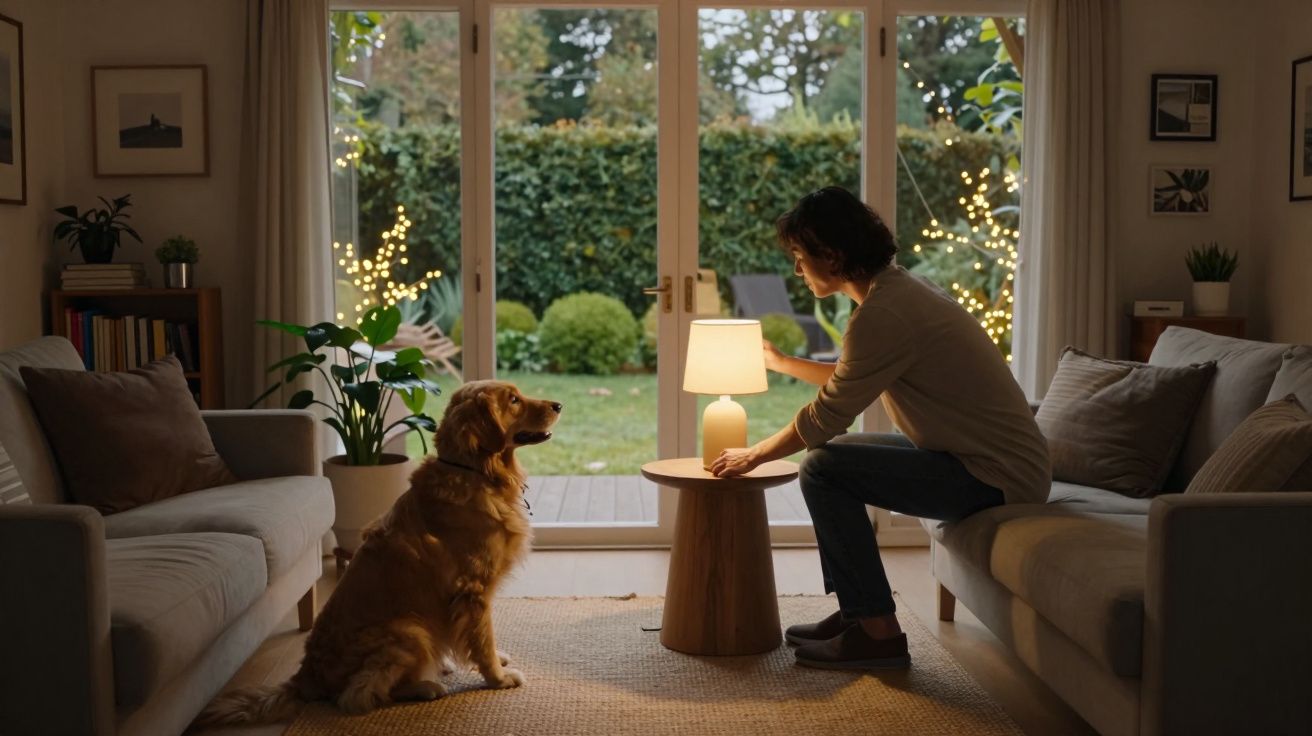
The first chill evening usually sneaks up on you. One week you’re still walking the dog in a T‑shirt; the next you’re fumbling for gloves and heading home in near-dark at half five. You get in, put the kettle on, and a few minutes later your dog is at the window or back door, barking at nothing – or at least nothing you can see.
By late October it can feel relentless. Every car door, every rustle, every neighbour’s footsteps seem to set them off. You apologise to the people next door. You tell yourself they’ll “get used to it”. Secretly, you wonder if you’ve somehow broken their training.
You probably haven’t. What’s changed is not your dog’s manners. It’s the light.
Behaviourists who work with noise and reactivity cases keep noticing the same pattern: many dogs bark more when the clocks go back and the house flips from daylight to glare-inside, black-outside. And there is one simple tweak they quietly recommend, long before they reach for anti‑bark gadgets or medication: change the way you light your evenings.
Not to make your home prettier. To make your dog’s world easier to read.
Why autumn evenings feel different to your dog
Your dog doesn’t just see less light in autumn; they see a different world.
Dogs are built for low light. Their eyes have more rods (the cells that pick up movement and dim shapes) and a reflective layer that bounces light back through the retina. That’s why torches make their eyes glow. At dusk their vision is working hard – but it’s tuned for soft gradients, not the brutal contrast that modern lighting creates.
When the sun goes down fast, the outside turns to a dark mirror. Inside, bright ceiling LEDs throw hard reflections on glass. To your dog, that can mean:
- A “strange dog” staring back from the patio door (their own reflection).
- Sudden silhouettes of people, foxes or cats flashing across a bright rectangle.
- Headlights and bike lights slicing through the dark like silent alarms.
All of this lands on a nervous system that’s already a bit more wound up. Cooler air, wind in dry leaves, more wildlife activity, fireworks, teenagers congregating at bus stops – autumn is noisier and smellier out there. A dog whose summer evenings were a gentle blur of garden naps is now on duty.
A behaviourist once put it simply: “Autumn doesn’t make dogs naughty. It makes their job description busier.”
Light, shadow and the “mystery outside”
Humans underestimate how much of a dog’s “guarding” or “startle” response is actually visual. We focus on sound – the car door, the bin lid, the neighbour’s gate. But what often tips a dog into barking is the half-seen shape that goes with the noise.
The way we light our homes can quietly amplify those shapes.
Bright, cool-white lights inside + almost no light outside create a huge contrast. Your windows become giant TV screens showing every tiny movement beyond the glass. To a dog whose job, in their own mind, is to notice change, that’s like turning the sensitivity dial to maximum.
Common problem set‑ups include:
- An open‑plan living room with big glass doors, lights blazing and the dog on the sofa facing out.
- A kitchen with a motion‑sensor floodlight that slams on whenever a fox, cat or delivery driver passes.
- A front room where the only outside light is from passing cars, which explode briefly across the curtains.
From our side of the glass, we shrug and say, “It’s just next door getting home.” From theirs, it’s: “Unidentified moving thing in my territory, again and again and again.”
A quick snapshot: when light makes it worse
| Trigger outside | What your dog sees | Lighting that magnifies it |
|---|---|---|
| Fox crosses lawn | Fast, low shadow near glass | Black garden + bright indoor spotlights |
| Neighbour’s door | Human figure + door frame flash | Dark landing + lit porch window |
| Car headlights | Sweeping beams & reflections | No steady outdoor light, shiny floors |
None of this means your dog is “overreacting”. It means the stage we’ve built for them is set for constant jump‑cuts and jump scares.
The simple tweak behaviourists recommend
The core idea is disarmingly plain: flatten the contrast between indoors and outdoors.
In practice, that means:
- Softening and warming the light *inside* in the early evening.
- Adding a steady, low‑glare light *outside* near the places your dog looks.
You are not trying to make the house brighter overall. You are trying to get rid of the black‑hole effect outside the glass and the interrogation‑room effect above your dog’s head.
Behaviourists often suggest a version of this routine:
- About an hour before it gets properly dark, switch from overheads to lamps. Use warm‑white bulbs (labelled 2700–3000K) rather than cool, blue-hued ones.
- At the same time, turn on a small, constant outdoor light near key windows or doors – a downlighter over the patio, a shaded wall light by the garden gate, even a solar lamp cluster aimed at the lawn.
- Close curtains or blinds where you can’t add outdoor light, especially large front windows at dog eye level.
- Disable or adjust harsh motion‑sensor floods so they don’t fire with every leaf or fox. Replace them, if possible, with softer security lighting aimed down, not straight into the room.
Behaviourist tip: “Aim for ‘cosy village lane’ rather than ‘petrol station forecourt’.” The dog doesn’t need bright; they need predictable.
Done consistently, this single change often reduces the number of “false alarms” a reactive dog gives in the first place. They see fewer jumpy silhouettes, fewer mirror-“intruders”, and more of the world as a calm, readable scene.
How to tell if light is part of the problem
Not every barking dog is triggered by lighting. Pain, anxiety, boredom, genuine fear and past experiences all play a part. But a few patterns strongly suggest that contrast and glare are making things worse:
- Barking is much heavier in autumn/winter evenings than in summer, even when routines are the same.
- The barking often starts right after lights come on inside or the outdoor floodlight triggers.
- Your dog fixates on windows, glass doors or shiny black TV screens, growling or lunging at “nothing”.
- When you draw the curtains, they settle significantly faster, even if noises continue.
If those sound familiar, adjusting the light is not a magic cure – but it is an unusually low‑effort, low‑risk piece of the puzzle that many people never try.
A 3‑evening experiment
Try this for three consecutive nights:
- Night 1: As normal – note when and where your dog barks, and what the room looks like.
- Night 2: Lamps only inside + one steady garden/porch light on from dusk + curtains closed where you can’t light outside.
- Night 3: Repeat Night 2, but move your dog’s resting place a little further from the glass (even a couple of metres helps).
You’re comparing not just how often they bark, but also how easily they can calm down afterwards. If the difference is clear, you’ve learned something useful about how their brain is processing the evening world.
Small evening changes that help alongside lighting
Light is the backdrop. Your dog’s arousal level is the volume control. The lower you can keep the overall “volume”, the less likely small triggers are to spill over into full‑throated alarm.
A few behaviourist‑approved tweaks:
- Shift intense play earlier. High‑energy games right after dark can leave them wired when the outside world is also noisy.
- Add a predictable “settle” period after the last walk: chew on a stuffed Kong, lick mat, or gentle scatter‑feeding on a rug.
- Use sound as a buffer. Low‑volume radio or brown‑noise in the room can smooth out sharp bangs and voices from outside.
- Give them a choice of safe spots away from windows: a covered crate, a bed behind the sofa, a box‑bed under the stairs.
If your dog chooses the darker, tucked‑away spot once the lights change, that is information: they are telling you what feels safest.
None of this replaces proper behavioural help for dogs who are truly distressed or aggressive. But it often means that by the time you speak to a professional, you’ve already removed one of the silent aggravators.
What this says about living with dogs now
Fifty years ago, many British dogs spent evenings in smaller, dimmer rooms, with curtains closed and a single standard lamp on. The outside was mostly dark. The line between “in here” and “out there” was simple.
Modern life blurs that line. Open‑plan spaces, floor‑to‑ceiling glass, security floods and giant TVs reflect a moving world back at our animals. We like the brightness; they live in the consequences.
Tweaking your lighting is not about making your home feel like a cave. It’s about meeting a dog halfway between their instincts and our architecture. When you flatten the contrast, you’re not just reducing barking. You’re telling your dog, in the clearest language you have: “Nothing mysterious is happening out there. You can stand down.”
And often, once the stage is calmer, they do.
FAQ:
- Should I leave a light on for my dog if I go out in the evening? Yes, but opt for a single, warm, low‑level lamp rather than all the ceiling spots. If their main view is of a garden or drive, pairing that with a soft outdoor light reduces reflections and sudden silhouettes.
- Won’t more outdoor light attract wildlife and make things worse? A steady, modest lamp is usually less exciting than a floodlight that snaps on and off. It lets both wildlife and your dog move without dramatic flashes that trigger alarm.
- Is barking at passers‑by just “normal guarding” I should ignore? Some alert barking is normal, but if it’s frequent, intense or hard for your dog to stop, it’s a welfare issue as well as a neighbour one. Adjusting light, routine and, if needed, working with a qualified behaviourist can all help.
- My dog is scared of fireworks and storms too – will lighting changes fix that? Not on their own. Noise phobias need a tailored plan, sometimes including medication. But calmer lighting and fewer visual surprises can reduce the number of other stressors piling on top of those big fears.



Comments
No comments yet. Be the first to comment!
Leave a Comment