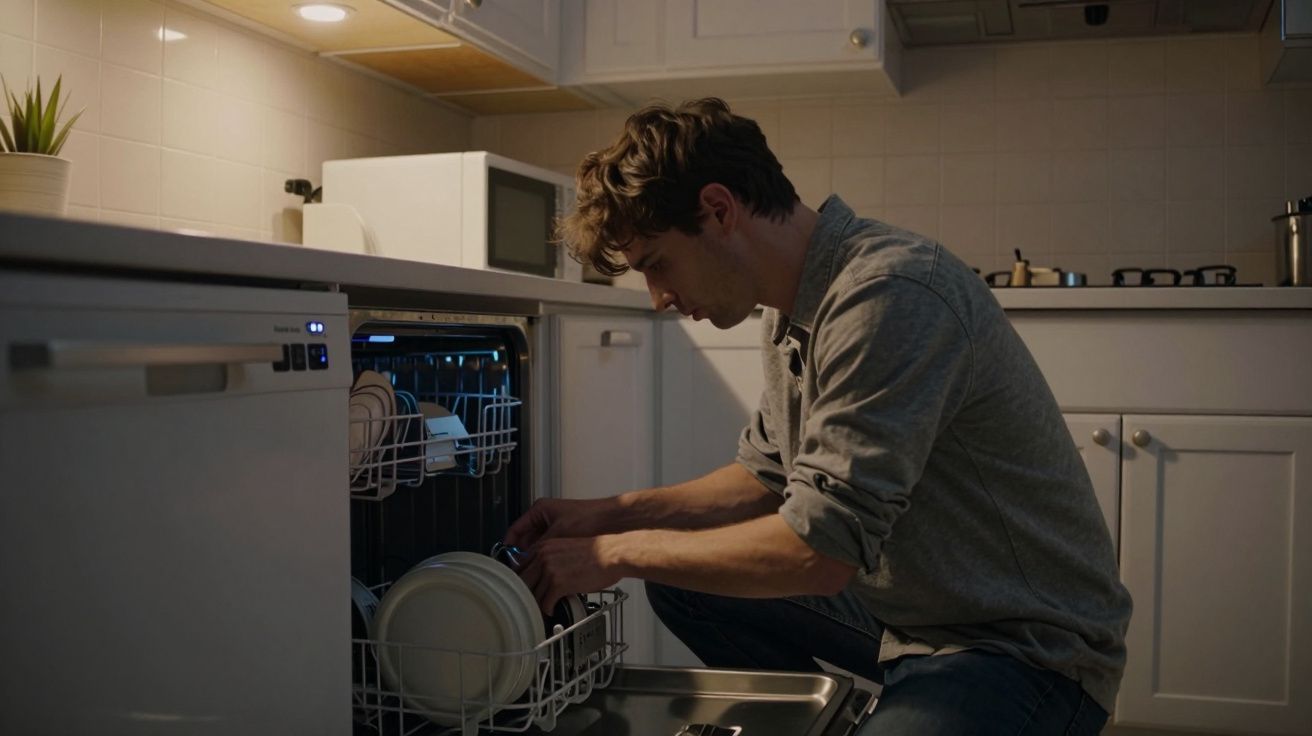
The plates were stacked, the counters almost clear, the hum of the dishwasher a soft backing track to a tired house. You hit the button, the light blinked on, and you padded upstairs with that small satisfaction of “tomorrow me will thank me”. Half an hour later, you were already forgetting it was even running.
Somewhere in the same town, someone did exactly that and woke instead to a shrieking alarm, a thick plastic smell, and orange at the edge of the kitchen door. The fire brigade report will log it in calm language: “suspected fault in dishwasher, property smoke-damaged, no injuries”. For them it’s Tuesday. For the family, it’s the night the kitchen changed colour.
We are sold two neat ideas at once: use your evenings to “get ahead”, and use cheap overnight electricity to save money. Appliance makers add delay-start buttons; energy apps nudge you to run big loads when you’re asleep. Fire services, meanwhile, keep repeating one deeply unglamorous rule: do not run dishwashers, washing machines or tumble dryers while you’re in bed or out of the house. Both can’t be fully right.
The tension sits in the space between your routine and a risk you almost never see.
Why bedtime feels like the perfect dishwasher slot
Night-time is where the dishwasher fits because your day doesn’t have space. After dinner you rinse the plates, stack the rack, add a tablet. The noise that would drown a phone call sounds gentle once you are upstairs. By morning, the machine is cool, the plastic has finished off-gassing, and the dishes are bone-dry. It feels efficient, almost virtuous.
Energy bills quietly push you that way. Off-peak tariffs and “time-of-use” plans reward you for running big appliances when the grid is quieter, often late evening through to early morning. Some apps literally badge you for shifting your dishwasher to 11 p.m. or beyond. The implication is clear: sleep through the cycle, wake up to savings.
There is also the mental load angle. Waking to a clear sink and empty worktop is not just neat; it makes breakfast easier, school runs faster, mornings calmer. We’ve all had that moment where you come down to last night’s pans and feel your day sag before 7 a.m.
On the surface, the “start it just before bed” habit patches all of that. Underneath, it hides a simple detail about how fire works.
How dishwashers actually go wrong
Most of the time, a dishwasher is a glass-lined box of hot water and steam with no drama. When it fails badly, it is almost never because “water caught fire”. It is the parts you forget are there.
Inside the plinth are heating elements, wiring looms, control boards and pumps. They sit in warm, damp conditions for years. Limescale creeps, connectors loosen, a tiny leak drips onto something that was never meant to be wet. A worn door seal lets steam into the control panel. Plastic baskets and panels slowly fatigue with heat.
In fire service investigations, the patterns repeat:
- A connection overheats and starts to smoulder behind the kickboard.
- A fault on the control board arcs and ignites nearby plastic.
- A leak drips onto live parts and causes tracking and flames.
You may not see open flames for several minutes. What you get first is toxic smoke from burning insulation and plastics. That smoke is the real killer in most house fires, especially at night when people are asleep and doors are closed.
Dishwashers are not the worst offenders – tumble dryers and washing machines cause more fires in UK statistics – but they are on the same list. And the common factor in the worst outcomes is not the brand or the model. It is that no-one was in the room when it went wrong.
The fire safety rule that spoils the habit
Ask UK fire services and they will say the same thing in slightly different words: do not leave washing machines, tumble dryers or dishwashers running while you are asleep or out of the house. The National Fire Chiefs Council repeats it. So do local brigades after every high-profile appliance blaze.
The reasoning is painfully simple. Fires grow on a timeline measured in minutes. The earlier you spot something burning, the smaller the fire, the easier it is to contain, and the less smoke everyone breathes. If you are awake and downstairs when something starts to smell wrong, you have options: hit stop, pull the plug if it is safe, close the door, call 999 from outside.
If you are asleep two floors up with the bedroom door shut, your first contact with that fire is when the smoke alarm has already decided things are bad. At that point, your job is not to be a hero with a tea towel. It is to get out.
This is the bit most of us quietly edit out of the “overnight dishwasher” story. We picture gentle white noise and cheap electricity, not a crew in yellow helmets trying to find our front door number through thick smoke.
So where does that leave the “just before bed” habit that does, undeniably, make daily life easier?
A safer compromise: when and how to run it
Fire services are not asking you to handwash pans at 11 p.m. and resent your life. They are asking you to shift supervision, not abandon convenience. That usually means one of three adjustments.
Run it earlier in the evening.
Load after dinner, but press start while you are still up – watching TV, putting children to bed, scrolling your phone. The riskiest parts of the cycle are the early heating and pump phases. Being awake for that period drastically improves your chances of noticing a problem.Use a morning start instead of an overnight one.
If your tariff has a cheap window that stretches into early morning, you can use the delay start to begin at 5 a.m., not 11 p.m., and be in the house and waking while it is running. You still catch lower rates, but you are conscious for more of the cycle.Redefine “just before bed”.
In practice, that might mean “an hour before you go upstairs”, not “as you turn the light off”. Give yourself time to notice odd sounds or smells and to intervene if needed.
Beyond timing, there is the boring but powerful layer: maintenance and loading. A clean, correctly used machine is much less likely to misbehave.
- Clean the filter and sump regularly. Grease and food build-up trap heat and can scorch.
- Check the spray arms and seals. Cracked plastic and perished rubbers make leaks more likely.
- Do not overload or wedge plastic against the element. If you can feel plates touching the heating rail, rearrange them.
- Plug in directly, not via a multi-way adaptor or extension lead. High loads and cheap blocks are a nasty mix.
- Register your appliance with the manufacturer so you hear about safety recalls.
None of that is glamorous. All of it tilts the odds quietly in your favour.
“Safety isn’t never using your dishwasher at night. It’s never letting it work unseen.”
- Be awake for at least the start of every cycle.
- Keep the machine clean, the filter clear, and the plug direct to the wall.
- Use delay-start to line up cheap power and supervision, not cheap power alone.
If you still choose to run it while you sleep
Some people will still press start on the way up the stairs. Work shifts are awkward, tariffs are strict, flats are small, life is messy. Let’s be honest: nobody reorganises their entire existence around the rinse programme.
If you are going to ignore the ideal and do it anyway, there are at least ways to soften, not solve, the risk:
- Smoke alarms on every level, tested monthly. You need time and noise on your side.
- Sleep with doors closed, escape routes clear. A shut kitchen door slows smoke; a clear hallway speeds you.
- Keep combustible clutter away from the machine. No spare tea towels, cardboard boxes or carrier bags piled near the kickboard.
- Do not run more than one big heat-producing appliance at once. If the dishwasher is on, leave the tumble dryer for tomorrow.
- Favour newer, well-maintained appliances. Old, unserviced machines with known faults are statistically worse bets.
It is important to be blunt: none of this makes overnight running “safe”. It makes it less unsafe than running an unmaintained 20-year-old dishwasher on an extension lead with no alarms fitted. The official advice still stands.
The quiet shift, if you are willing to make it, is to aim for “unattended but awake” instead of “unattended and unconscious”.
The real choice: savings, sleep, and seconds
When you strip away the marketing, the question is not “Should I run the dishwasher at night?” It is: “How much am I willing to trade a small energy saving for a small but real safety margin?” On most bills, the difference between a 9 p.m. run and a midnight one is measured in tens of pence. The difference between spotting a fault in its first minute and waking ten minutes later to thick smoke is measured in hospital admissions and rebuilding costs.
You will not see a TV advert for “Run it at eight and sit in the same house as your appliances.” It does not make for slick lifestyle content. What it does make for is fewer 3 a.m. kitchen fires.
Think of it this way: bedtime is for you, not for your machines. Let them do the loud, hot work while you are still around to notice if they ask for help.
| Key point | Detail | Why it matters |
|---|---|---|
| Supervision beats silence | Run dishwashers while you’re awake, not asleep or out | You can spot smells, sounds and smoke early and act |
| Timing tweaks, not martyrdom | Use evening or early-morning starts within cheap windows | You still harness tariffs without fully unattended nights |
| Maintenance is quiet protection | Clean filters, check seals, avoid extensions and overloads | Reduces the chance of faults escalating into fires |
FAQ:
- Is it ever truly “safe” to run a dishwasher overnight? No appliance is zero-risk, and fire services advise against running them while you sleep. You can reduce risk with alarms, maintenance and wiring, but the safest option is to run it when you are awake.
- Are dishwashers really a common cause of house fires? They are less common than tumble dryers and washing machines but still feature in UK fire statistics each year. The severity of incidents is often linked to whether anyone was awake to notice early signs.
- What if my electricity is only cheap after midnight? Consider programming the start for early morning when you are waking, or shifting other routines so you can run it late evening instead. The financial saving from strict overnight use is usually modest compared with the safety trade-off.
- Do modern machines with safety features change the advice? Newer dishwashers may include leak detection, temperature cut-outs and better wiring, which all help. However, fire services still recommend not leaving them running while you sleep, as no system can cover every fault.
- Does it make a difference if the kitchen door is closed? Yes. A closed door can slow smoke and heat spread, buying you time. But it can also delay your noticing a fire, which is why alarms and being awake remain crucial.






Comments
No comments yet. Be the first to comment!
Leave a Comment