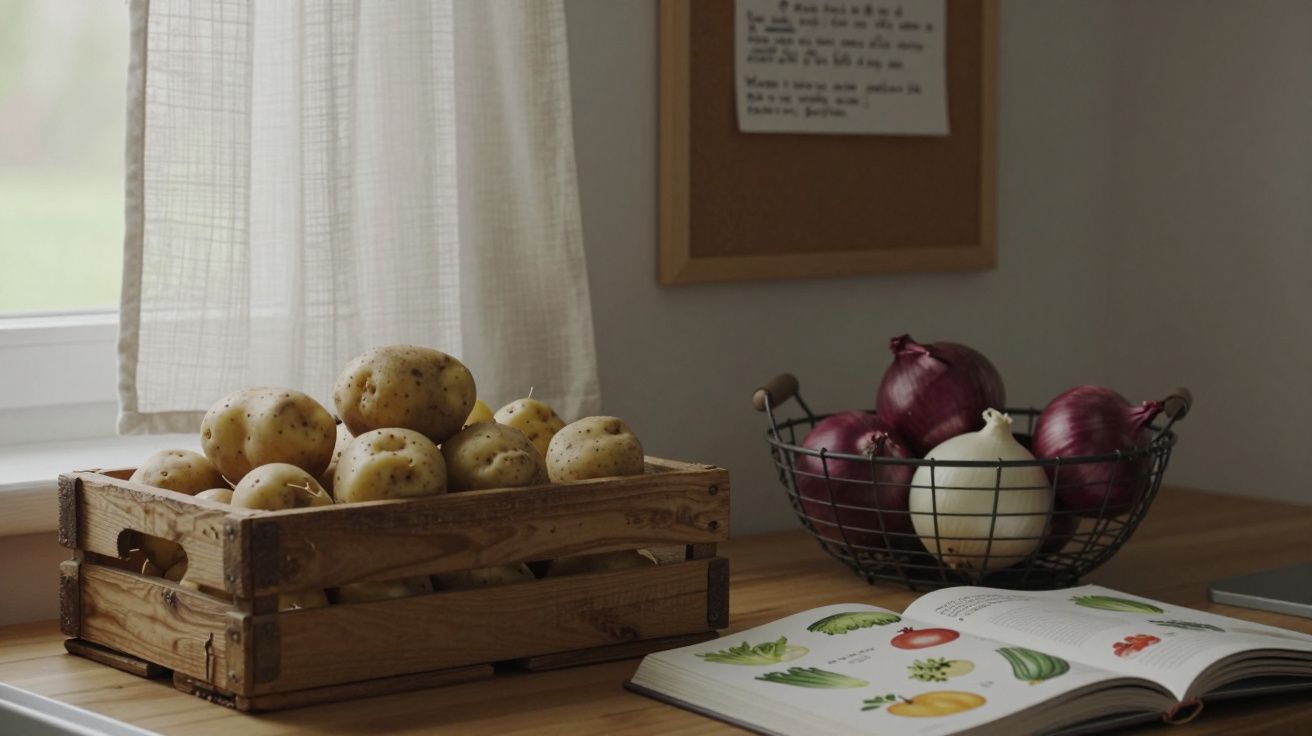
You buy a big bag of potatoes to “save money”, sling in a net of onions because they’re right there, and a fortnight later you’re fishing out soft, sprouting spuds and onions with a beard of mould. The cupboard smells vaguely of compost, and half your good intentions go in the bin. It feels mysterious, but it’s not. You’ve accidentally built the perfect little spoilage machine under the sink.
Spend five minutes watching a proper greengrocer unpack a delivery and you’ll notice something quietly telling: sacks of potatoes over here, crates of onions over there, air moving between them. They never live cuddled together in a dark, sweaty cupboard. There’s a simple reason – and a storage tweak you can copy in any kitchen, however small.
The invisible gas that ruins a bag of spuds
Onions and their cousins (shallots, spring onions) naturally release ethylene, a plant hormone gas. It’s colourless, odourless and surprisingly bossy. Ethylene is what tells fruit and veg to ripen, sprout or senesce. In a field, that’s helpful timing. In a cramped cupboard, it’s chaos.
Potatoes are especially sensitive to ethylene. When you park a bag of spuds right next to onions, that gas builds up around the tubers. The potatoes respond by:
- Sprouting faster
- Turning sweet and then oddly off in flavour
- Softening more quickly
At the same time, both potatoes and onions are alive and breathing. They respire slowly, releasing moisture and a little heat. In a tight, still space the air turns warm and humid. That’s exactly the sort of microclimate that encourages rot, not storage.
So you have three things happening at once: ethylene telling potatoes to age in fast-forward, rising humidity softening skins, and poor ventilation trapping spores and smells. Keeping them snuggled together simply concentrates all three.
Potatoes vs onions: they like different weather
The second problem is that potatoes and onions prefer almost opposite storage climates once they’re out of the ground.
| Food | Likes | Hates |
|---|---|---|
| Potatoes | Cool, dark, slightly humid air; steady temperature | Light, warmth, very dry air, fridges |
| Onions | Cool, dry, airy; low humidity, lots of circulation | Damp cupboards, plastic bags, sitting on moist veg |
Potatoes keep best around 6–10°C, in the dark, with fairly high humidity so they don’t shrivel. That’s why old houses had cool cellars and wooden bins. Onions, by contrast, want it dry and breezy; too much moisture and they mould from the neck down.
When you cram them together in the same basket or bag:
- Potatoes lose the slightly humid, steady conditions they like.
- Onions sit in a moister, stiller pocket of air, especially if the potatoes are in plastic.
Both lose. The potatoes age and sprout, the onions rot from the base or develop that sour, musty smell that tells you the inner layers are going.
Where things go wrong at home
Most of the classic “my veg goes off so quickly” habits come down to two errors: wrong container and no air movement.
Common culprits:
- Keeping both in sealed plastic bags, trapping moist, ethylene‑rich air.
- Storing them in a warm cupboard above the oven or beside the fridge motor.
- Letting onions sit directly on damp potatoes at the bottom of a bowl.
- Piling veg high in a deep box so the bottom layer never sees a breeze.
The fridge doesn’t magically fix it either. Potatoes chilled for long periods convert their starch to sugars, giving you oddly sweet, dark‑browning chips and mash that tastes “off”. Onions can cope in the fridge in a breathable bag, but that’s solving the wrong problem if you’re still crowding them with potatoes.
How greengrocers get weeks out of a sack
Talk to a market trader and they’ll say it in different ways, but the rule is always the same: separate and circulate.
Behind the scenes, you’ll usually see:
- Sacks of potatoes on pallets or open slats, off the floor, stacked no higher than they can still feel a draught.
- Onions in mesh bags or shallow crates, never in sealed boxes, often stored higher up and drier.
- Clear gaps between stacks, so air can move around and between them.
- A cool, shaded corner, away from direct sun and away from heat sources.
They’re not being fussy for fun. Air movement does three things:
- Carries ethylene and moisture away instead of letting them build up.
- Keeps temperatures more even, so you don’t get warm, sweaty pockets.
- Lets surfaces dry if there’s any condensation, which stops neck rot in onions and mould on potato skins.
You don’t need a warehouse to copy this logic. You just need to stop treating your veg cupboard like a sealed storage box.
The simple circulation set‑up for a small kitchen
You can mimic the greengrocer’s system with two cheap containers and a bit of distance.
Step 1: Pick the right spot
Look for:
- A cool, dark area: a pantry, under‑stairs cupboard, bottom of a wardrobe, or the coolest part of the kitchen.
- Away from: oven sides, boiler cupboards, radiators, sunny windowsills, dishwasher vents.
If your kitchen runs hot, even a hallway shoe rack or shaded corner of the sitting room can be a better bet than that toasty cupboard above the hob.
Step 2: Give each crop its own breathable home
Use:
- For potatoes: a slatted wooden crate, paper sack, or hessian bag. No plastic liners. Roll the top loosely, don’t tie it shut.
- For onions: a mesh bag, wire basket or shallow crate so air can reach every bulb. Single or double layers only.
Avoid deep solid boxes; the bottom layer will sit in stagnant air and fail first.
Step 3: Build in space and air
Once they’re in separate containers:
- Leave a gap of at least a few inches between potatoes and onions, further if you can.
- Don’t wedge containers hard against walls on all sides; leave at least one side and the top open to the room.
- If they must share a cupboard, put potatoes lower, onions higher, with a clear shelf between.
Think in terms of letting the air “wash through” the space. If you open the cupboard door and it smells strongly of onion, there isn’t enough circulation.
Step 4: Quick weekly check
Once a week, when you grab an onion or a few spuds:
- Lift the top layer and check for soft, shrivelled or mouldy pieces.
- Remove anything suspect immediately; one bad onion will take others with it.
- If the inside of the container feels damp, dry it out and spread the veg in a thinner layer for a day.
Those thirty seconds will buy you days, sometimes weeks, of extra life.
Fast rules to remember
You don’t need to memorise storage textbooks. A handful of cues covers most of it:
- Never keep potatoes and onions in the same bag or bowl.
- Choose breathable containers (paper, hessian, wood, mesh), not sealed plastic.
- Store both somewhere cool, dark, and away from heat, with onions in the driest, airiest spot.
- Keep a little space around everything, so air can move and smells don’t build up.
- Check once a week and use up anything starting to sprout or soften first.
Do that, and you’ll stop treating veg as semi‑disposable. A 2.5 kg bag of potatoes and a net of onions can last you through a run of busy weeks instead of turning into an expensive science experiment.
Quick comparison: what goes wrong and how to fix it
| Issue | Likely cause | Simple circulation fix |
|---|---|---|
| Potatoes sprouting fast | Stored next to onions in still air; too warm or bright | Move to cooler, darker spot in paper/hessian; separate from onions |
| Onions going mouldy at neck | Humid cupboard, no airflow; sitting on moist veg | Transfer to mesh bag or wire basket; keep dry and in a single layer |
| Musty veg cupboard smell | Ethylene and moisture trapped in sealed space | Use breathable containers; leave gaps; open door daily to vent |
FAQ:
- Can I keep potatoes and onions in the same cupboard at all? Yes, if the space is cool and aired, but give them separate containers and a gap between. Think “same room, different beds”, not piled together.
- Is it ever OK to put potatoes in the fridge? For long-term cold storage before cooking chips or roasties, some chefs chill them then parboil to remove excess sugar. For everyday home use, it’s simpler and safer to keep them in a cool cupboard instead.
- What about garlic – does it need its own spot too? Garlic behaves more like onions. Store it dry and airy, and it’s fine to keep with onions but still away from potatoes if you can.
- Do red onions or new potatoes follow different rules? The same principles apply. Thin‑skinned new potatoes are even more sensitive to dryness and warmth, so good circulation and cool, dark storage matter even more.
- My kitchen is tiny – what’s the one change that helps most? Get them out of sealed plastic and out from right beside the oven or hob. Even moving them to a paper bag on a cool floor in the hall is a big upgrade.

Comments
No comments yet. Be the first to comment!
Leave a Comment