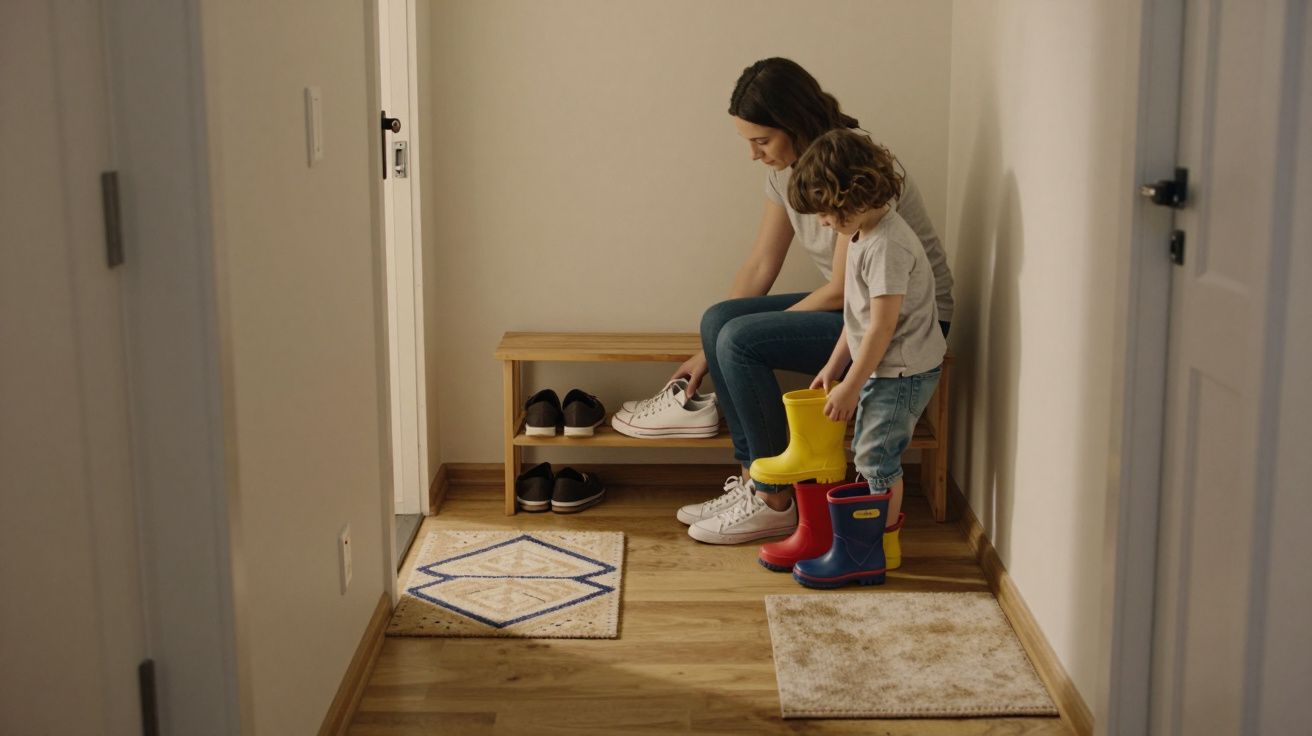
The evening we finally got the carpets cleaned, I stood in the hallway feeling absurdly proud. The pile looked fluffier, the whole flat smelled faintly of citrus instead of dog. Then the environmental health friend I’d invited for dinner pointed at the jumble of trainers and boots by the door.
“That,” she said, nudging a muddy sole with her toe, “is your main pollution source.”
It sounded dramatic. We live on a reasonably quiet street, nowhere near a factory. But a few weeks later she sent through a set of dust results from a small study she was running. The hallway, the rug by the sofa, the corner where the kids play with Lego – all showed the same thing. The outside world was quietly piling up inside, one step at a time.
Why the clean-looking hallway can be dirtier than the pavement
Most of us picture pollution as something “out there”: exhaust pipes, chimneys, hazy skies over a city ring road. Indoors feels safer by default. Yet health researchers keep repeating the same awkward finding: air and dust inside our homes often contain higher concentrations of certain pollutants than the air on the street.
The reason is part chemistry, part habit. Cooking, candles and cleaning products add their own fumes, but the foundation layer is plain old dust. Every time we walk through the front door with shoes on, we deliver a fresh top-up of whatever is on the pavement, the car park, the park path or the garden path.
In many homes, that delivery route ends at the doormat. Shoes land in a pile, the mat looks satisfyingly grubby, and we assume the dirt has stayed put. In practice, fine particles don’t politely stay on the mat. They cling to soles and sides, shake loose as shoes are pulled off, drift into nearby rugs, and are stirred back into the air each time someone walks past, vacuums or opens a window.
Several housing studies in Europe and North America point to the same pattern: a significant share of indoor lead, pesticides and road dust is “tracked-in” from outside, and homes with strict shoe-off habits tend to have lower levels of these contaminants in floor dust. The hallway is not just messy. It is the loading bay for your home’s pollution.
What exactly are you walking into the house?
If you could shrink down and ride on a shoe sole for an afternoon, the tour would be eye-opening. It is not just visible mud that hops a lift home.
Health researchers regularly find:
Road dust and tyre particles
Microscopic fragments from tyres and brake pads settle on pavements and car parks. These can contain metals and chemical additives that hitch a ride indoors.Pesticides and lawn treatments
Herbicides from sprayed verges, weed killer from driveways, and lawn treatments cling to soil and grass, then to soles. Indoor studies often detect exactly the same compounds in house dust.Industrial and traffic residues
Soot, PAHs (polycyclic aromatic hydrocarbons) from exhaust, and tiny particles from industrial areas do not disappear at the front step. They just get thinner and harder to see.Faecal bacteria and parasites
Dog mess that has “mostly washed away”, bird droppings, puddles near bins – all can leave behind microbes. Even if you cannot see or smell it, the genetic traces show up on lab swabs.Microplastics
Fragments from artificial turf, litter, packaging and fibres from clothing accumulate in outdoor dust and then in indoor dust. Once inside, they are hard to remove completely.
Individually, a speck of road dust or a trace of herbicide on a sole does not sound alarming. The issue is cumulative exposure in enclosed spaces, especially for children and pets who spend more time on or near the floor, and for anyone with asthma, allergies or other lung conditions.
One housing survey that compared “shoes-on” versus “shoes-off” homes found that floor dust in shoes-off homes often carried noticeably lower levels of pesticide residues and some metals. The researchers were blunt in their summary: if you want cleaner indoor dust, start with your feet.
Why this matters more than it seems
For a long time, indoor dust was treated as a nuisance, not a health topic. Now it is under the microscope – literally.
Dust is where many pollutants settle and concentrate. We then:
- breathe particles back into our lungs as they’re stirred up
- touch dusty surfaces and put our hands to our face
- watch babies crawl through it and put toys (and toes) in their mouths
- let pets groom it off their fur
That means even low-level contamination can matter over years. Lead in dust, for instance, is far more strongly linked to children’s blood lead levels than lead in outdoor soil. Pesticide traces in house dust can reflect how much we have brought in on footwear and clothes, not just what we spray indoors.
Researchers do not suggest you live in fear of your floor. Instead, they highlight how powerful small, repeated choices can be. When they model different scenarios, two habits keep popping up as high-impact and low-effort:
- leaving outdoor shoes at the door
- vacuuming and dusting in ways that trap, rather than simply rearrange, fine particles
Taken together, those steps can cut the amount of certain contaminants circulating in a home by a surprisingly large margin.
| Source outside | What it brings in | Who it affects most |
|---|---|---|
| Roads, car parks | Metals, tyre dust, exhaust residues | Asthmatics, people with heart or lung disease |
| Lawns, verges, driveways | Herbicides, pesticides, fertiliser residues | Children, pets, gardeners |
| Paths, parks, dog-walk routes | Faecal bacteria, parasites, soil microbes | Babies, toddlers, barefoot wanderers |
The quiet power of a “shoes-off at the door” rule
One reason this topic is awkward is social, not scientific. Many of us grew up in homes where visitors were expected to keep their shoes on, both as a courtesy and to avoid that moment of standing in someone else’s hallway in mismatched socks.
Yet from a pollution point of view, changing what happens in the first two square metres of your home does more good than any fancy air purifier in the lounge. You are tackling the problem at the source.
The most effective set-up is plain and almost boring:
- a sturdy, washable mat outside the door and another just inside
- a small bench or stool so people can sit to remove shoes
- a simple rack or tray with enough room that shoes are not stacked on top of each other
- a basket of clean socks or slippers for guests who feel odd being barefoot
In trials where families agreed to a “no outdoor shoes past this line” experiment, researchers measured not just dust but behaviour. The first week felt deliberate and slightly fussy. By the third or fourth week it had become muscle memory. Children adapted the fastest; visiting adults took longer, but most followed whatever the host did without comment.
Let’s be honest: nobody manages this perfectly every day. There will be rushed mornings where someone clatters through the flat in football boots, a delivery person who steps inside without thinking, or a party where the rule quietly dissolves. The goal is not perfection. It is to make shoes-off the default, shoes-on the exception.
Cleaning so the dust actually leaves
A door policy makes a big difference, but it does not erase the dust already there. The way you clean can either help it leave the building or send it back into the air for another circuit.
Health and building researchers tend to recommend:
Vacuum with a good filter
A vacuum with a HEPA or similar high-efficiency filter traps fine particles instead of blasting them out the back. Focus on entrances, corridors and areas where children play on the floor.Damp dust instead of dry flicking
A slightly damp microfibre cloth or mop captures dust. A dry feather duster mostly relocates it from surface to air.Wash mats and shoe racks regularly
Removable, machine-washable mats are ideal. If yours are not washable, take them outside for a firm shake or beat, away from open windows.Think low-down first
Start with skirting boards, floors and rugs, then move upwards. This matters most in homes with crawling babies or curious pets.
Again, the value is in rhythm, not heroics. A focused 10–15 minutes on high-traffic areas once or twice a week often beats an occasional deep clean that leaves you exhausted and reluctant to repeat it.
Making it work in real homes (and with real people)
It is one thing to know that shoes-on living brings in more pollution. It is another to change long-set habits, housemates and all.
People who make the switch and stick with it share a few common tweaks:
They explain the “why” simply.
“We keep outside shoes by the door – it keeps the floors cleaner for the kids and the dog,” is usually enough. Most visitors are happy to follow suit when they understand it is not just about muddy footprints.They make the clean choice the easy choice.
If taking shoes off requires a small balancing act in a narrow hallway with nowhere to put them, people will avoid it. A stool and a rack change that equation.They focus on the zones that matter most.
Maybe you cannot police every doorway in a shared flat. Starting with bedrooms and children’s play areas still cuts a lot of exposure.They give themselves permission to be flexible.
Builders, emergency plumbers, relatives with mobility issues – there will always be cases where shoes stay on. Protect floors with an old sheet or ask if they are happy to use over-shoe covers, then let it go.
One researcher who has worked on indoor pollution for decades put it this way:
“I used to dream of getting every family to buy an air cleaner. Now I just hope they’ll take their shoes off and vacuum the hallway. It is mundane, but the numbers move.”
FAQ:
- Is going “shoes-off” really that much better for indoor air?
Studies comparing homes with and without shoe-off habits regularly find lower levels of certain pollutants – including pesticides and metals – in the floor dust of shoes-off homes. It is not a magic shield, but it is a high-impact, low-effort change.- What if we live in a flat without much hallway space?
Use a slim rack or tray just inside the door and a folding stool if needed. Even a clear “shoe line” on a mat and a basket for slippers helps contain most of the tracked-in dirt to a small area.- Do I need special “anti-pollution” mats?
Not really. Any sturdy, textured mat that can be shaken or washed works. Having one mat outside and one inside catches more debris than a single mat alone.- Is this mainly about germs or chemicals?
Both. Shoes can carry bacteria, parasites and viruses on their soles, as well as chemical residues from roads, lawns and industrial areas. A shoes-off policy reduces the flow of all of these into living spaces.- If I cannot convince everyone to remove shoes, is there still any point?
Yes. Even partial changes – like always going shoes-off in bedrooms and children’s rooms, or after walks in muddy or treated areas – lower the overall burden in the dust that builds up indoors.

Comments
No comments yet. Be the first to comment!
Leave a Comment