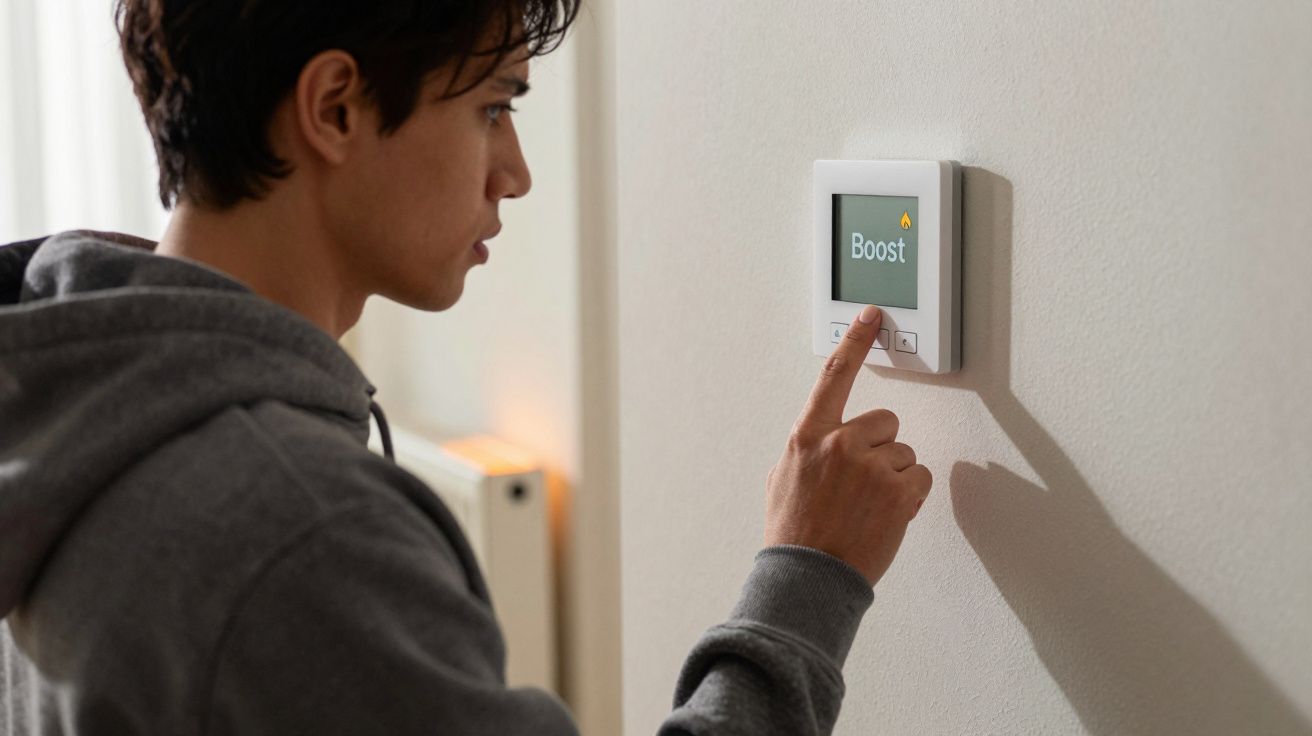
The living room feels colder than it looked on the weather app. You shrug on a hoodie, pad over to the thermostat and jab the big inviting button: Boost. A neat little flame icon glows. The app says “Heating on for 2 hours”. The radiators start to tick. Problem solved, you think.
It feels clever because it feels temporary. Not turning the heating “on”, just nudging it. Not changing all your schedules, just a quick blast. A bit like hitting “pay now” instead of setting up a direct debit – more control, more tactical.
Except boost isn’t a tactical nudge. In many homes it’s the panic button that turns your cheapest heating into the most expensive setting in the house.
And the worst bit? Most people press it precisely when it hurts their wallet the most: tired, cold, and not quite paying attention to what it’s actually doing in the background.
What the boost button really does to your heating
On most systems, boost means “forget the plan, go full power right now for a fixed time”. It doesn’t think about prices, outside temperatures, or how warm the house already is. It simply shouts at your boiler or heaters to run harder or longer than they otherwise would.
For a gas boiler, that often means pushing high flow temperatures round every radiator, even rooms you don’t need. For a heat pump or storage heater, boost can be more brutal: it may quietly switch on direct electric elements at peak rates, bypassing all the clever efficiency you paid for.
Boost is usually an override, not a turbo mode. It cancels the brains of your system and leans on its most basic, most expensive muscles.
Manufacturers love the button because it cuts complaints: cold living room? Boost. Guests arriving early? Boost. But energy advisers see the same pattern every winter. People who “only use the heating a bit” discover a bill that looks like they’ve been running it flat out.
The hidden difference between “more heat” and “more expensive heat”
Not all heat in your home costs the same, even from the same box on the wall.
- Scheduled, steady heating lets a boiler or heat pump cruise at efficient levels.
- Off‑peak charging (Economy 7/10, storage heaters) buys cheap night‑time electricity.
- Boost often jumps to the wrong time of day, at the wrong power level, in every room.
You still feel “a bit warmer”. Your meter feels the difference sharply.
When cheap systems turn into the priciest setting in the house
The danger zone is any set‑up where your main system can be cheap, but only when used as designed. Boost often side‑steps that design completely.
1. Electric storage heaters and Economy tariffs
Old‑style storage heaters are meant to soak up low‑cost electricity overnight, then leak it out gently in the day. Touch the “Boost” or “On‑peak” setting, and many models flick to instant electric heating at daytime prices.
That means:
- Instead of ~10–15p per kWh off‑peak, you may be paying 30p+.
- The heater stops relying on stored heat and behaves like a giant fan heater.
- People think the tariff is “a rip‑off”, when it’s the boost button eating the savings.
One housing officer described walking into flats where every storage heater boost light was on, all afternoon, all winter. The tenants were rationing hot water and cooking, but their most expensive setting was glowing happily against the skirting boards.
2. Heat pumps with “immersion” or “emergency heat”
Many modern heat pumps carry a built‑in electric back‑up. It’s there for rare, icy snap conditions or defrost cycles. Boost or “hot water boost” can flip that back‑up on for hours.
- A well‑set heat pump might give 3 units of heat for 1 unit of electricity.
- An immersion or electric back‑up gives 1 unit of heat for 1 unit of electricity.
- Boost can quietly drag you from efficient heat pump mode to pure electric heater mode.
On paper, that sleek outdoor unit is cheap to run. In reality, a couple of over‑enthusiastic evening boosts can cancel the week’s savings.
3. Gas boilers and “crank it to max” logic
With gas, the damage is less dramatic per hour, but it builds.
A long boost at a high set‑point can:
- Overheat already‑warm rooms, wasting gas.
- Make the boiler cycle on and off more, reducing efficiency and lifespan.
- Undo the benefits of low‑and‑slow radiator temperatures that condensing boilers love.
People then cool off by cracking a window, not by cancelling boost. You literally throw paid‑for heat into the street.
The timing trap: why boost loves peak prices
Energy is rarely cheapest at the exact moment you feel coldest. You’re most likely to stab at the thermostat:
- Just after getting home from work or the school run.
- Late at night when the heating has already wound down.
- On a frosty morning when you’ve turned it “off to save money”.
Those are classic peak‑use windows, especially on dynamic and time‑of‑use tariffs. Boost doesn’t know you’re on a clever rate that rewards early pre‑heating. It just feeds the meter whatever it asks for, right now.
| Scenario | What people think boost does | What it usually actually does | | --- | --- | | “Quick warm‑up before bed” | Adds a little extra heat to one room | Runs the whole system hard for 1–3 hours at peak rates | | “Kids are chilly after bath” | Nudges bathroom and bedrooms only | Fires the boiler for the entire circuit, including empty rooms | | “House feels cold at 6pm” | Makes up for a weak schedule cheaply | Shifts demand into the most expensive part of the day |
Boost feels precise. On many systems it’s brutally blunt.
How to spot if the boost button is draining your wallet
You don’t need a smart meter PhD, just a little curiosity for a week.
Quick checks anyone can do
Watch the meter when you press boost
Note the reading, press boost, check again 30 minutes later. A sharp jump compared with your usual background use is a warning.Check which lights come on
On storage heaters and cylinders, if a separate red “Boost” or “On‑peak” light glows, you’re likely using top‑rate electricity.Look in the app history
Smart thermostats often log when boosts happen. Clusters around 7–9am and 5–10pm on weekdays are a classic “wrong time” pattern.Compare rooms
If rarely used rooms feel toasty during a boost, your system probably isn’t zoning well. You’re paying to heat air and furniture, not people.
A calmer way to get warm without pressing panic
You don’t need to swear off boost forever. You just need to make it your last resort, not your first reflex.
1. Fix the schedule so you don’t need boost so often
Think in head starts, not heroic rescues.
- Set heating to come on 30–60 minutes before you usually feel cold, at a sensible temperature.
- Use a lower setback temperature (e.g. 16–18°C) instead of turning it fully off, so the system doesn’t have to race from icy to cosy.
- For heat pumps, keep flow temperatures modest and steady; they thrive on “always on, gently”.
You want the house to feel quietly fine most of the time, not boom‑and‑bust between freezing and tropical.
2. Use zones properly, or fake them
If you have smart TRVs or zones, tie boosts to rooms, not the whole house. A short living‑room‑only boost is far cheaper than igniting every radiator.
No zones? Fake it:
- Turn radiator valves down in spare rooms and corridors.
- Close doors so the heat you buy stays where you are.
- Use draught excluders on the worst gaps; they cost less than an hour of whole‑house boosting.
3. Reserve boost for very specific jobs
Decide in advance what boost is for in your home. For example:
- Half‑hour boost on the bathroom circuit on winter mornings only.
- One‑off hot water boost if guests arrive and the cylinder’s low.
- Emergency “we came back from holiday to a 10°C house” warm‑up.
Write that rule on a sticky note near the thermostat if you have to. The goal is to stop bored thumbs from jabbing boost by habit.
Small settings that make a big difference
The manuals and apps are dry, but two minutes here pays back all winter.
Shorten the default boost time
Many thermostats default to 2 or 3 hours. If you can, knock it down to 30 or 60 minutes.Lower the boost temperature
If boost jumps you to 24–25°C, you’ll overshoot and waste energy. Aim for 19–21°C and dress for winter.Tame hot water boost
Set cylinder thermostats sensibly (around 60°C) and avoid multiple daily boosts. Constantly reheating a full tank you don’t use is pure waste.Turn off “max comfort” gimmicks
Some smart systems have comfort modes that auto‑boost when they “detect occupancy”. If you’re on a tight budget or a pricey tariff, keep them off.
Think in patterns, not moments: a tiny tweak you use every day beats one dramatic change you forget about next week.
When boost actually is the right move
There are times when paying more for heat briefly is rational.
- Short‑term tenants or guests who can’t re‑programme the whole system.
- Health needs where a cold snap is riskier than a higher bill.
- Frozen‑pipe prevention if the heating has been off and temperatures plunge.
Even then, it’s worth pairing boost with common‑sense insulation: shut doors, close curtains, block draughts. The more of that boosted heat you trap, the less you’ll need.
FAQ:
- Should I stop using the boost button completely?
Not necessarily. Treat it like an emergency override, not everyday control. Used rarely and for short periods, it’s fine. Used daily as your main way of managing heat, it’s usually expensive.- Is boost always more costly than normal heating?
In many systems, yes, because it runs at peak times or higher power. On a flat‑rate tariff with a simple gas boiler, the difference is smaller, but you can still waste money by overheating empty rooms.- How warm should I set my thermostat to avoid constant boosts?
Most advice in the UK suggests around 18–21°C. Pick the lowest temperature at which you feel comfortable in warm clothes and hold it steadily, rather than swinging up and down.- Does turning the heating off when I go out save more than using setback temperatures?
If you’re away for days, off makes sense. For normal workdays or evenings out, a modest setback is often cheaper and comfier than turning off and then hammering boost to catch up.- How can I tell if my storage heater boost is costing a lot?
Check your bill for separate day and night rates. If you regularly run boost during the day, you’re paying the higher rate. Aim to charge heaters overnight and rely on output controls, using boost only briefly and sparingly.





Comments
No comments yet. Be the first to comment!
Leave a Comment