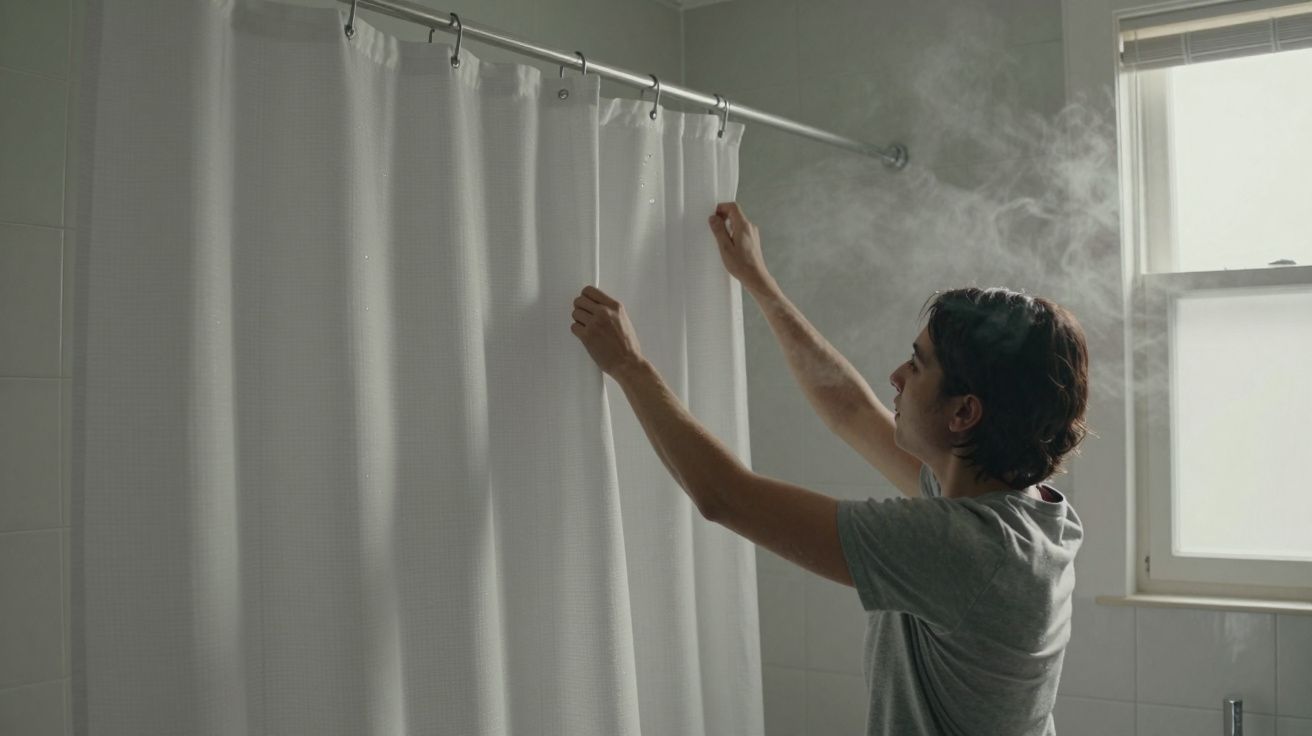
By Friday night, the curtain looked fine. A quick wipe of the sink, a spritz of air freshener, door closed, lights off. By Monday morning, there they were: tiny black specks creeping along the bottom hem, the faint grey shadow in the folds where the plastic never quite dries. Three days, a handful of showers, no major leaks – and the start of that tell-tale mildew smell.
You haven’t changed your cleaner. You haven’t skipped showers for weeks. The only thing that’s stayed absolutely the same is the way everyone gets out, yanks the curtain aside and walks away. The habit is so automatic you barely see it happening.
That’s the problem. And the fix takes less time than it does to grab a towel.
The tiny habit that feeds black mould
Most bathrooms don’t grow mould because you’re “dirty”. They grow mould because you give moisture nowhere else to go.
The quickest way to do that is also the most common: you finish washing, pull the curtain right back to one end and leave it scrunched in damp folds. The cold wall, the still air and the trapped water in those pleats create a perfect little greenhouse.
Fabric, vinyl, “mould-resistant” liners – it doesn’t really matter. If the curtain is bunched up, pressed against tiles, or sitting in a wet bath or tray, the same thing happens. Water clings in the creases, soap scum and skin cells provide food, and the warm, steamy room does the rest.
You don’t see it straight away. For the first day or two it just looks “wet”. But in those dark folds, mould spores – which are already floating around in the air – are getting exactly what they want.
Why it appears in days, not weeks
Black mould doesn’t need months to show up. In a modern, well-used bathroom it can get going in 24–72 hours.
Every shower sends warm, humid air into a small room. If that humidity has no quick escape route – no fan on, no window open, door shut right after you leave – it condenses on the coolest surfaces. Your curtain is one of the biggest.
Where the curtain lies flat and can drip-dry, moisture runs off. Where it is folded, rolled or pressed into a corner, the water just sits. Those tiny standing puddles in the creases are where the first grey shadow appears.
Health-wise, that shadow matters. Mould spores can irritate your airways, trigger asthma, and cause coughing or itchy eyes, especially in children or anyone with allergies. The sooner you stop it taking hold on soft surfaces like curtains, the easier it is to keep the whole room under control.
The 5‑second fix after every shower
The good news: the most powerful anti-mould habit you can build takes roughly the time it takes to hang your towel.
Do this as the last thing you do before you leave the bathroom:
- Turn the water off, then give the curtain a quick shake. Two or three firm flicks are enough to knock off the heaviest droplets so they don’t sit in the folds.
- Pull the curtain fully across the rail so it hangs flat. No bunching at the ends, no big pleats, no part stuck to the wall. Think “smooth sheet”, not “concertina”.
- Make sure the bottom edge hangs inside the bath or shower tray. That way, water can drip straight down and not onto the floor or silicone seals.
- Leave the extractor fan running or the window slightly open. Fifteen minutes of airflow makes a huge difference. If you can, leave the door ajar too.
That’s it. No sprays, no scrubbing, no special tools. Just a tiny “exit ritual” that lets the curtain dry quickly instead of stewing in its own steam.
If you want to go one step further, run a dry hand towel quickly along the bottom 20–30 cm of the curtain once a day. It adds maybe three more seconds and removes the damp edge where black spots usually start.
Small tweaks that stop mould creeping back
Once the five-second fix is in place, a few light-touch habits keep things under control without turning your bathroom into a chemistry lab.
- Wash the curtain regularly. Fabric curtains usually go in the washing machine (check the label) with a mild detergent and a low spin. For plastic liners, soak in a bath of warm water with a splash of white vinegar, then rinse and re-hang to dry.
- Keep bottles off the hem. Shampoo and body wash sitting on the bottom edge weigh it down, stop it drying and drip sugary residue that mould loves.
- Trim the length if it pools. If your curtain sits in the bath or tray, cut or re-hem it so it just brushes the inside edge instead of gathering water.
- Use the fan like a light switch. On when you shower, off at least 15 minutes after. If there’s no fan, a slightly open window plus open door is your best bet.
- Clean little and often. A quick weekly wipe along the hem and side edges with a cloth and mild bathroom cleaner is usually enough if you’re drying it properly.
Think of the curtain as something that needs to breathe. Any time it’s trapped, folded, or wet for hours, mould wins.
If the black spots are already there
Once you can see black or dark green specks, you’re dealing with established mould, not just simple damp. You can still save most curtains if you act early.
- Take it down and treat it outside the bathroom so you’re not spreading spores around the room.
- For fabric curtains: pre-treat the worst areas with a mould spray or a paste of bicarbonate of soda and a little water. Then wash hot if the care label allows. Dry fully before rehanging.
- For plastic/vinyl liners: spray the affected patches with a bathroom mould remover or a mix of 1 part thin bleach to 3 parts water. Leave for a few minutes, scrub gently with a soft brush, then rinse thoroughly.
- If the mould is heavy and the material is thin or old, it’s often safer – and frankly less stressful – to replace the curtain and start your new drying habit from day one.
Always ventilate well when you’re using bleach or mould sprays and wear gloves. The goal is a quick reset, not a lungful of fumes.
At-a-glance: what to stop and what to start
| Habit | What it does |
|---|---|
| Leaving the curtain bunched at one end | Traps water in folds, creates dark, still pockets where mould spreads fast |
| Letting the hem sit in pooled water | Keeps fabric or plastic constantly wet, stains and rots the edge |
| Pulling curtain flat and letting it drip-dry inside the bath | Spreads moisture out so it dries quickly, starving mould of the damp it needs |
Making everyone in the house actually do it
Bathrooms usually fail on consistency, not knowledge. One person dries the curtain; three others don’t.
A few nudges help:
- Move the curtain ring by the tap. So the last hand to touch the shower controls naturally slides the curtain across.
- Stick a short reminder on the mirror. “Pull the curtain flat – mould hates dry” is enough to jog memory.
- Show kids the “why”. Point out the black spots and then show how they avoid them. Visuals work better than lectures.
- Pair it with a habit everyone already has. “Tap off, curtain across, towel on rail.” One smooth motion.
You don’t need perfection. If most showers end with those five seconds of care, the mould simply doesn’t get the conditions it needs to explode.
FAQ:
- Should I leave the curtain open instead of closed to stop mould?
Leaving it open and bunched is what causes the problem. Leaving it closed but stretched flat lets air reach the whole surface so it dries faster and stays clearer.- Do I need to spray the curtain with anti-mould products every day?
No. Daily drying does most of the work. Reserve mould sprays or diluted bleach for occasional deep cleans or visible growth, not as a constant routine.- Is a fabric or plastic curtain better for avoiding mould?
Both can grow mould if left wet and scrunched. Fabric is easier to machine-wash; plastic is easy to wipe. The drying habit matters far more than the material.- What if I don’t have an extractor fan or a window?
Open the bathroom door as soon as you’re done, pull the curtain flat, and avoid very long, very hot showers. A small freestanding dehumidifier outside the bathroom door can also help in very damp homes.- Can I just switch to a glass screen and forget about it?
Glass doesn’t mould in the same way, but the seals and tracks around it will if they stay wet. You still need airflow and a quick wipe-down, just in different places.



Comments
No comments yet. Be the first to comment!
Leave a Comment