By the time you fish that third soggy cucumber out of the vegetable drawer, you start to suspect it’s not you, it’s them. You buy them fresh, line them up with the best intentions-salads, sandwiches, maybe even a batch of tzatziki-and then three days later they’re bendy, leaking, and smelling faintly of regret. The fridge that’s meant to keep things crisp seems to quietly melt cucumbers on contact.
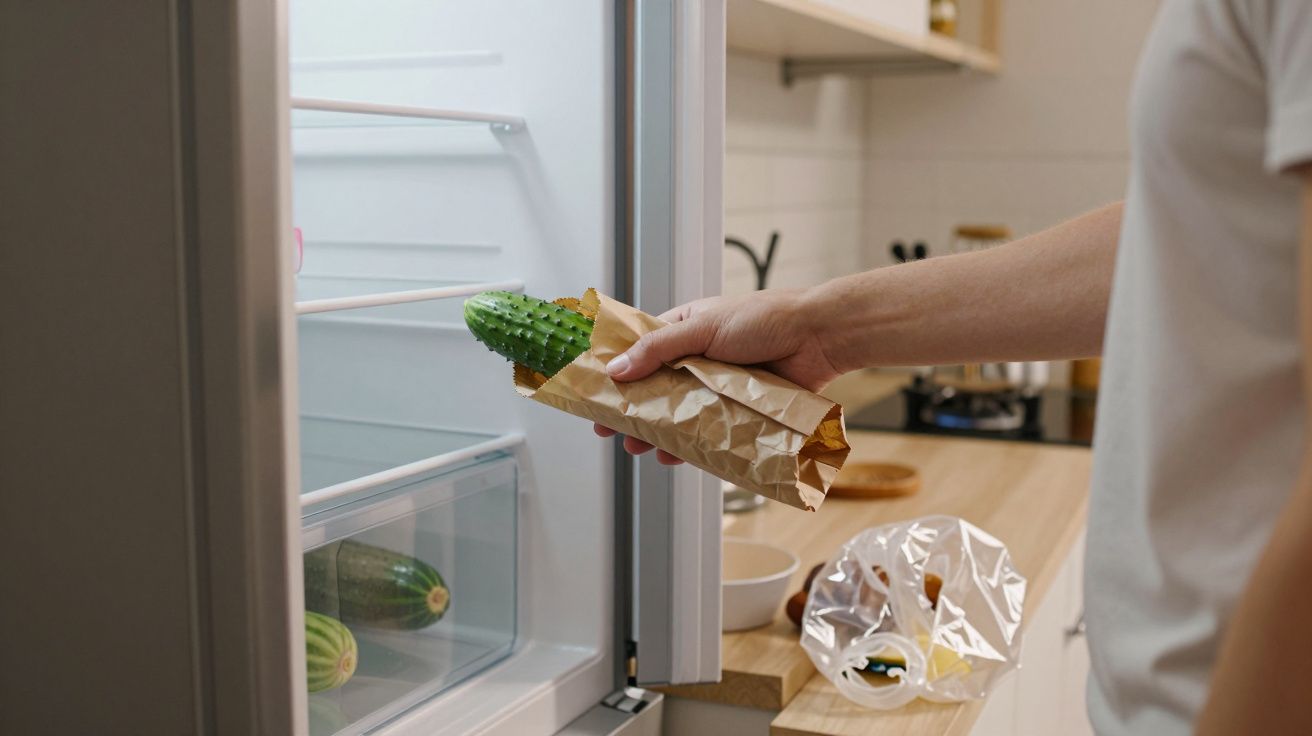
You scroll through storage hacks: plastic boxes, special mats, expensive “produce savers”. Then someone’s nan on TikTok does something annoyingly low-tech. She slides a perfectly ordinary cucumber into a plain brown paper bag, tucks it into the fridge, and comes back more than a week later to one that still snaps when she slices it.
No special container. No vacuum seal. Just a paper bag, a shelf, and a promise that this time, the cucumber might live long enough to meet the hummus.
The quiet disaster in the vegetable drawer
Nobody plans to waste vegetables. It happens in slow motion, somewhere behind the yoghurt and the leftover takeaway. You remember the cucumbers only when you need one, reach into the drawer, and your fingers close around something limp instead of solid. You do the small guilty dance: prod it, sniff it, then slide it into the bin with a sigh.
Most of us treat cucumbers like any other salad item-straight into the crisper in the supermarket plastic, or decanted into a plastic box “to keep them fresh”. It feels logical: seal in the moisture, stop them drying out. What actually happens is the opposite. The cucumber breathes, releases water, and the plastic traps it against the skin. Tiny beads of condensation form, and within days the once-firm surface becomes a slippery, collapsing mess.
The problem isn’t that cucumbers dry out in the fridge; it’s that they suffocate in their own damp breath.
Once you see it that way, the paper bag trick makes a different kind of sense. It doesn’t add more technology. It adds a tiny bit of breathing room.
Why cucumbers collapse so fast
Think of a cucumber as a tube made mostly of water held together by thin cell walls. When those walls are under gentle tension, it feels crisp and snappy. When they lose that tension-through age, temperature shock, or too much moisture-the whole structure slumps.
Three things gang up on cucumbers in a typical fridge:
- Cold shock: Shoved straight from a warm shop into a very cold fridge, cells can be stressed, which speeds up softening.
- Trapped humidity: Plastic bags and cling film hold every droplet of moisture against the skin, softening it and encouraging rot.
- Ethylene neighbours: Sitting right next to apples, tomatoes or ripe bananas exposes cucumbers to ripening gas that nudges them towards spoilage.
Cucumbers like a slightly humid but well-ventilated environment-enough moisture to stop them shrivelling, but enough airflow to keep condensation from clinging. Your fridge rarely offers that by default.
That’s where a paper bag quietly changes the weather.
How the paper bag trick actually works
A paper bag doesn’t sound like much. That’s the beauty of it. It does three small jobs at once: it shields, it soaks, and it lets air move.
Here’s the basic setup:
- Start dry. Pat your cucumbers dry if there are any water droplets on the skin. Wet going in means soggy coming out.
- Keep them whole. Store them uncut if you can. Once sliced, cucumbers lose moisture faster and invite bacteria in.
- Add a liner (optional but powerful). Wrap each cucumber loosely in a clean, dry sheet of kitchen paper.
- Slide into a plain paper bag. A standard brown paper bag from a bakery or greengrocer is perfect. Fold the top once-don’t roll it tight.
- Tuck into the fridge. Ideally in the crisper drawer, away from very wet veg and strong-smelling foods.
What happens next is quietly clever:
- The paper absorbs excess surface moisture, so droplets don’t sit on the skin and start rot.
- The bag slows down airflow just enough to stop the cucumber dehydrating and going rubbery.
- Tiny gaps in the paper let ethylene and excess humidity escape, so your cucumbers aren’t trapped in a mini sauna.
Result: cucumbers that routinely stay firm and usable for 7–10 days, sometimes longer, instead of giving up by day three.
A paper bag doesn’t keep cucumbers “fresh forever”; it just gives them reasonable working conditions.
Paper vs plastic vs “naked” in the drawer
You can feel the difference with your hands. After a week:
| Storage method | What you usually find | Best use by then |
|---|---|---|
| Supermarket plastic | Sweaty skin, soft patches, odd smell | Soup, smoothies, bin for worst bits |
| Loose in drawer | Wrinkled ends, uneven texture | Grated into salads, raita, quick pickles |
| Paper bag (with liner) | Still firm, slight dulling of skin only | Sliced, sticks, salads-normal use |
Not every cucumber will last the same time-age, variety, and how it was handled before you bought it still matter-but the paper bag shifts the odds quietly in your favour.
A week in the life of a paper-bagged cucumber
You won’t get a cinematic before-and-after. You’ll get something better: the absence of disappointment.
Days 1–3: The non-event
In the first few days, nothing dramatic happens. That’s the point. The cucumber you forgot about on Wednesday still feels like the one you bought on Sunday. The skin looks matte rather than glossy, but it doesn’t slide under your fingers. When you cut into it, the centre is damp but not watery, the seeds still seated, not floating in a mushy channel.
You start to trust that grabbing a cucumber won’t mean rewriting the evening’s dinner plan.
Days 4–7: The “is this still okay?” test
This is when, in the old routine, you’d be doing a bin-or-salad decision. With the paper bag, you do a quick check instead:
- Does it feel reasonably solid from end to end?
- Is the skin intact, without obvious wet patches or dark spots?
- Does it smell like nothing much, just mild and green?
If yes, you slice it. The crunch is slightly softer than day one-but still a crunch, not a bend. For most home cooks, this is all that matters. The cucumber is ready for sandwiches, crudités, or a salad that doesn’t feel like penance.
Days 8–10: The bonus zone
By this stage, you’re in “over a week” territory. If you’re used to emergency rescues on day four, this feels like theft from the bin.
The ends might be a little softer. You can trim those off. Inside, the flesh is paler and the seeds a bit more pronounced, but still firm enough to slice cleanly. This is when many people pivot to:
- Ribbon salads with a punchy dressing
- Yoghurt-based dips where texture matters less
- Quick pickles, sliced thin and brined
The win isn’t perfection on day ten. It’s edibility on a day when you’d normally be scraping mush off the chopping board.
Small habit, surprisingly big ripple
Like the 2-litre water bottle on your desk, the paper bag becomes a quiet background player that changes more than it claims to.
Once you know cucumbers will behave for a full week:
- You’re more likely to buy a multipack when they’re cheaper, knowing they won’t melt on you.
- You start planning actual salads for Thursday instead of resigning them to “whatever’s still alive”.
- That last-minute takeaway becomes slightly less tempting when you know there are usable vegetables waiting.
People who adopt the trick often mention a low-level satisfaction that has nothing to do with recipes. Less food waste, fewer guilty bin trips, fewer mystery liquids to wipe out of the drawer. Your fridge feels less like a vegetable graveyard and more like a pantry that keeps its promises.
There’s also the ego-saving element: you realise you’re not “bad at fresh food”. You just never gave your cucumbers a fair environment before.
Common tweaks and mistakes
Like any kitchen habit, the paper bag trick has its fine print.
Helpful tweaks:
- Double up in humid fridges. If your fridge tends to be damp, use both a kitchen paper wrap and the bag.
- Label the bag. A quick pencil note (“Cucumbers – bought Sat”) helps you keep track without playing fridge roulette.
- Keep away from very wet veg. Don’t let the bag sit in a puddle under leaky salad leaves.
Things that backfire:
- Sealing the bag tight. Folding the top three times turns it into plastic with worse visibility. One loose fold is enough.
- Storing cut cucumbers the same way. Once cut, shift pieces to an airtight container lined with paper, and use within 2–3 days.
- Washing before storage. Rinse only when you’re about to use them. Extra water at the start just feeds mould.
The rule of thumb: dry in, gently wrapped, loosely covered, quietly ignored.
What this tiny trick does for how you cook
It’s tempting to think of storage tips as housekeeping trivia. Yet they shape what actually lands on your plate.
Knowing your cucumbers will last:
- Makes meal planning less brittle-you can move Tuesday’s salad to Friday without losing half the ingredients.
- Lets you experiment-try that chilled cucumber soup or extra side dish without gambling on a last-minute dash to the shop.
- Gives you permission to buy better produce, not just whatever’s on offer, because you’re confident it will be eaten, not binned.
It’s not a revolution. It’s a quiet tune-up of how your fridge works for you instead of against you.
And somewhere between week one and week three of using a boring old paper bag, you notice something small but stubborn: the drawer opens, the cucumber is firm, and you stop bracing for disappointment. It’s just there, ready to slice, ready to be part of dinner. That’s all the magic most of us were asking for.
FAQ:
- Does the paper bag trick work for mini cucumbers as well as full-size ones? Yes. Mini cucumbers often last even longer because they’re picked younger and have fewer internal voids. Treat them the same way: keep them dry, loosely wrapped, and in a paper bag in the fridge.
- Can I reuse the same paper bag? You can, as long as it stays dry and clean. Once it shows dark spots, tears, or feels damp, recycle or compost it and switch to a fresh bag.
- What if I don’t have a paper bag? A cardboard box or a shallow tray lined and loosely covered with kitchen paper offers a similar effect: absorb moisture, allow gentle airflow, avoid tight seals.
- Should cucumbers ever be stored at room temperature? Short term, yes-if you’ll use them within a day or two, they’re happy on the counter out of direct sun. For keeping them firm beyond that, the fridge-plus-paper-bag combo is more reliable.
- Does this trick work for other vegetables? Variations of it do. Courgettes, peppers and fresh herbs also benefit from dry skins, absorbent liners, and breathable covers. The exact timing changes, but the principle-moisture managed, air allowed-stays the same.




Comments
No comments yet. Be the first to comment!
Leave a Comment