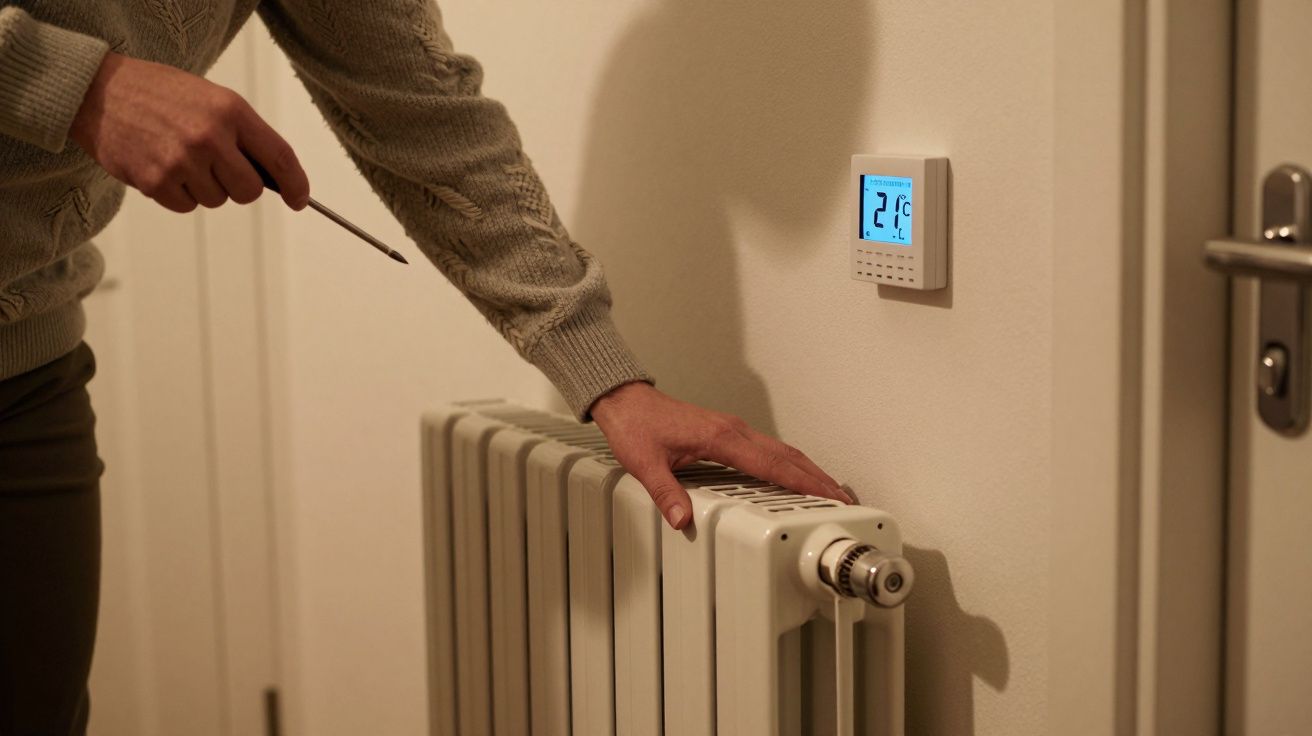
The first time I realised my radiators were quietly stealing money from my gas bill, I was standing in the hallway in a jumper and socks, touching one hot panel and one lukewarm one, wondering how the same boiler could feel so different in two rooms.
The thermostat said 20°C. The living room said “maybe 17 if you’re lucky”. I’d bled the radiators, cranked the boiler, cursed the landlord in my head. Still, one room was a sauna and the next felt like a bus stop. It didn’t feel like a dramatic “broken boiler” moment. It felt like something was just… off.
A heating engineer came round on a cheap call-out deal. He didn’t start with the boiler. He walked straight to the nearest radiator, tapped the corner with his knuckles, then did something I’d never seen before: a simple ten‑second hand test on a couple of radiators. Two minutes later he said, “You’re not short of heat. You’re wasting it. This system just isn’t balanced.”
He didn’t replace anything expensive. He didn’t suggest a new boiler. He took out a small screwdriver, a pair of pliers, and spent half an hour quietly fiddling with the “hidden” valves you never touch. The difference that evening was embarrassing. I’d been sitting in a cold room for months because of something that cost about 50p in water and a bit of patience to fix.
The 10‑second test that tells you if your heat is going astray
You don’t need a thermometer or a plumber’s toolkit to spot a wasteful system. You can do the basic check in under a minute once the heating’s on.
Let your heating run for 20–30 minutes so everything has warmed through. Then, one radiator at a time:
- Touch the top corner on the side with the valve. It should feel properly hot, but not painful – you can use the back of your hand if you’re cautious.
- Slide your hand down to the bottom of the same radiator.
- Compare it to another radiator, especially one further from the boiler.
What you’re looking for:
- Top hot, bottom slightly cooler: good. That’s normal – hot water in at the top, cooler water out at the bottom.
- Top hot, bottom stone cold all the way across: likely air or sludge – that radiator is barely doing any work.
- One or two radiators blazing hot while others are just warm or tepid: classic sign your system is badly unbalanced.
- Radiators heating in a strict order: nearest to the boiler roasting first, the last one only getting warm after ages – again, an imbalance.
Ten seconds per radiator is enough to spot a pattern. You’re not trying to be precise, you’re trying to answer one simple question: is the heat being shared fairly, or is one part of the system hogging it?
If the system is unbalanced, your boiler will happily churn out more heat to try to satisfy the cold rooms. The hot rooms get hotter, windows get opened, gas goes up the flue. You pay for all of it.
What your hands are actually measuring
Behind that quick touch test is a simple bit of physics your boiler relies on.
Water leaves the boiler hot, flows through the pipework and radiators, and comes back cooler. The boiler expects that temperature drop. It’s how it knows the radiators are giving off heat into the rooms rather than just pumping hot water round in circles.
When things are set up properly:
- Each radiator gets enough hot water, but not all of it.
- The water slows down a bit through each radiator, gives off heat, then moves on.
- The return water coming back to the boiler is noticeably cooler than the flow going out.
When a system is badly balanced:
- The radiators closest to the boiler offer almost no resistance. Water races through them, stays very hot, and comes back still hot.
- Distant radiators barely see any flow, so they never really warm up.
- Your boiler sees hot water leaving and hot water coming back and starts to short‑cycle: on, off, on, off, all day.
That’s bad news in three ways:
- Your condensing boiler may never actually condense properly, so you lose efficiency.
- Rooms at the end of the line are cold, so you keep turning the thermostat up.
- Pumps and components wear faster from constant cycling.
Your hand on the radiator is a free, rough‑and‑ready temperature probe. If the first radiator is scorching top and bottom, and the last one is barely lukewarm even after half an hour, the system isn’t “weak”. It’s unfair.
The cheap fix most engineers start with: balancing
When a heating engineer talks about balancing a system, they almost always mean one thing: adjusting the little “hidden” valve on each radiator – the lockshield – so the hot water is shared out more evenly.
You probably know the obvious valve you turn by hand or with a plastic head: that’s your on/off or thermostatic valve. The lockshield is usually on the other side, often under a plastic cap, sometimes paint‑splattered, almost always ignored.
Balancing is simple in theory:
- Radiators near the boiler are throttled down a bit at the lockshield so they don’t steal all the flow.
- Radiators far from the boiler are opened up more so they get their fair share.
- The aim is to get all radiators heating up at roughly the same rate, with a reasonable temperature drop top‑to‑bottom and flow‑to‑return.
It’s one of the first things a good engineer will check because:
- It costs almost nothing – no parts, just time.
- It can reclaim a surprising amount of comfort and efficiency.
- It often fixes “my boiler is useless” complaints without touching the boiler.
You can do a light version yourself if you’re comfortable with small adjustments and a bit of trial and error.
How to do a DIY light‑balance (the safe, slow way)
If you’re renting or just cautious, you don’t have to do a full engineer‑level balance. A gentle tidy‑up of the worst offenders can still help a lot.
Before you touch anything:
- Make sure the system is off and cool.
- Take photos of each radiator valve from above and from the side. If you get lost, you can always put it back.
Then:
Bleed the radiators first.
Use a radiator key and a towel. Let out trapped air until water appears, then close. Air pockets can mimic balancing problems, so solve the obvious thing first.Find the lockshield on each radiator.
Usually under a plain white cap or metal cover opposite the adjustable valve. You may need pliers or a small spanner to turn it.Start with the hottest, fastest‑heating radiator.
This is normally closest to the boiler or the first on the circuit. When the heating has been on 15–20 minutes, use your hand test:- If it’s roasting hot top and bottom while others are lagging, it’s probably taking too much flow.
Turn its lockshield slightly towards closed.
We’re talking tiny moves: an eighth or a quarter of a turn.- Wait 10–15 minutes, then compare again.
- The aim is for it to still get hot, just not absurdly faster than the others.
Repeat the process along the line.
- Very hot radiators: gently throttle down a touch.
- Struggling radiators: make sure their lockshield is fully open, then investigate if they’re still cold (could be sludge or a separate fault).
- Very hot radiators: gently throttle down a touch.
Give it a proper test.
Let the system run for an hour, doors open, and walk round:- Do the radiators now feel more similar?
- Has that “cold room” climbed a couple of degrees without pushing the thermostat higher?
You don’t need perfection. Even getting rid of the worst hogs and giving the end‑of‑line radiators a fair shot can change how your home feels.
If anything worries you – seized valves, leaks, strange boiler noises – stop and call a professional. Balancing is cheap; breaking a valve isn’t.
Quick guide: what your radiator is telling you
You can use this as a crib sheet once you’ve done the 10‑second test.
| What you feel with your hand | Likely cause | DIY or call a pro? |
|---|---|---|
| Top hot, bottom slightly cooler, room comfortable | Working normally | Leave it alone |
| Top hot, bottom cold across whole width | Air or sludge build‑up | Bleed first; if still bad, consider a flush (pro) |
| One or two radiators blazing, others weak | System out of balance | Light DIY balance or ask an engineer |
| All radiators lukewarm, boiler running constantly | Boiler settings or pump issue | Check flow temperature and timer; then pro |
| Gurgling noises, patchy heat, rusty water when bleeding | Air and corrosion | Bleed, add inhibitor (pro for dosing) |
None of this needs expensive smart gadgets. A lot of engineers will walk in with the same senses you have: eyes, ears, hands, and a small screwdriver.
Why balancing saves money, not just jumpers
The obvious win is comfort: fewer “cold spots”, fewer family arguments about the thermostat, fewer evenings huddled by one good radiator.
But there are quieter savings happening in the background when you’re balanced:
Lower flow temperature actually starts to work.
Many people have heard you can save money by turning the boiler’s flow temperature down. That only really works if the heat is shared properly. With a balanced system, you can often shave the flow temp from, say, 75°C down to 60–65°C and stay comfortable – which helps a condensing boiler run more efficiently.Short‑cycling drops.
When the boiler isn’t slamming on and off because the first radiator is satisfied and the rest are starving, parts last longer and you waste less gas in warm‑up phases.You stop opening windows to fix bad rooms.
The classic move: roasting bedroom, icy living room, window cracked open upstairs while the thermostat calls for more heat downstairs. That’s money literally out the window.
Balancing won’t magically halve your bill, but for the cost of an engineer’s hour – or a careful DIY afternoon – it can move you from “system feels broken” to “system finally makes sense”.
A simple weekend checklist
If you want to act on this without turning it into a full‑time hobby, here’s a short plan:
- Run the heating for 20–30 minutes and do the 10‑second hand test on every radiator.
- Bleed any radiator with gurgling, obvious cold tops, or patchy heat.
- Note which radiators are ridiculously hot compared with the rest – those are your prime candidates for a slight lockshield tweak.
- Do a gentle, conservative light‑balance on the worst offenders only.
- Once things feel more even, experiment with knocking the boiler flow temperature down a notch and see if the house still feels comfortable after a couple of days.
Small, boring tweaks add up. You don’t need a new boiler to stop wasting heat. You just need to make sure the old one isn’t working against a badly set‑up system.
FAQ:
- Is it safe to touch a hot radiator for this test?
Yes, as long as you’re sensible. Most systems are set below scalding temperatures, but always use the back of your hand, touch briefly, and pull away if it feels too hot. If anyone in the house is vulnerable, you can use a cheap infrared thermometer instead.- Will balancing my radiators definitely cut my gas bill?
It usually helps, but it’s not a silver bullet. Balancing makes your system capable of running more efficiently, especially with a lower flow temperature. Your actual bill depends on insulation, thermostat habits, and how warm you like the house.- How do I know which radiator is “closest” to the boiler?
It’s not always the physically nearest one. A good hint is the radiator that gets hot first when the heating comes on. That’s typically near the start of the circuit and often the one that needs throttling back a little.- What if one radiator stays cold even when its valves are fully open?
If you’ve bled it, confirmed both valves are open, and nearby radiators are fine, you may have a blockage or pipework issue. That’s when it’s worth getting an engineer to check for sludge or a stuck valve rather than forcing anything.- Do I need to rebalance every year?
Usually not. Once a system is properly balanced, it stays roughly there unless you add, remove, or change radiators, pumps, or pipework. An occasional check when you bleed radiators before winter is enough for most homes.



Comments
No comments yet. Be the first to comment!
Leave a Comment